The relationship between employers and employees is not always the easiest. In fact, they are often fraught with disagreements. In cases where the relationship between the parties has broken down and an amicable solution can no longer be found, parties often seek legal recourse at the courts of law.
In Malaysia, action in respect of employment disputes in the first instance can be initiated at the Labour Court, Industrial Court or the Civil Courts (i.e. Magistrate, Sessions or High Court). However, which court is the correct court for your matter and what is the difference?
LABOUR COURT
It might come as a surprise, but officially, Labour Court is not a statutory tribunal and is not part of the official court hierarchy in Malaysia (i.e. Magistrate Court, Sessions Court, High Court, Court of Appeal and Federal Court). So if the Labour Court is not technically a court of law, then what is the Labour Court?
The Labour Court actually refers to inquiries before the Director General of Labour (“DGL”) pursuant to Section 69 of the Employment Act 1955. It can be better described as a forum where the DGL holds inquiries into complaints regarding employment matters. It is only by convention that inquiry by the DGL is called the Labour Court. In fact, the Labour Court itself also uses the Bahasa Malaysia terminology “Mahkamah Buruh” to refer to inquiries by the DGL.
What kind of cases does the Labour Court hear?
The DGL can only hear cases that involve employees (that is those persons who are under a contract of service) regardless of salary and those that involve contractors for labour (a contractor who supplies labour). Matters which are typically heard before the DGL are as follows:-
- unpaid wages and/or other payments due under an employment agreement (contract of service) which may include overtime pay, sick leave, annual leave and other such payments
- unpaid sums due to a contractor for labour against a principal, contractor or sub-contractor for labour supplied
- indemnity in lieu of notice (either by the employee or employer)
- dismissal for misconduct (remedy is limited to the payment of indemnity in lieu of notice and other payments that the employee is entitled to as if no misconduct was committed by the employee)
What is the proceeding at the Labour Court?
Summary of proceedings at the Labour Court
- a complaint is made against the Defendant and a claim is filed with the DGL
- DGL sends a letter to inform the Defendant of the details of the claim and the case mention date
- if a settlement cannot be reached during the case mention date, the DGL will summon the parties for a hearing (where evidence may be presented and witnesses may be called)
- after the hearing, the DGL will make his/her decision
What kinds of awards can the Labour Court make?
The Labour Court can order payments of unpaid wages, payments in lieu of notice period and/or other payments due under an employment agreement (contract of service) which may include overtime pay, sick leave, annual leave etc.
In respect of dismissal for misconduct, the Labour court has no jurisdiction to order remedies such as reinstatement, compensation in lieu of reinstatement or backwages and such claims which remain the jurisdiction of the Industrial Court.
A failure to comply with the DGL’s decision can attract a fine of up to RM50,000 and in the case of a continuing offence after conviction, a daily fine of up to RM1,000/day. The DGL’s decision at the Labour Court can be enforced by the Magistrate/Sessions Court and can also be appealed to the High Court.
INDUSTRIAL COURT
Unlike the Labour Court, the Industrial Court is a statutory tribunal established under the Industrial Relations Act 1967 (“IRA”). Malaysia has five Industrial Courts located respectively at Kuala Lumpur, Johor, Perak, Pahang, Sabah, and Sarawak.
What kinds of cases do the Industrial Court hear?
The jurisdiction of the Industrial Court is wider than the Labour Court. The cases heard by the Industrial court include:-
- unfair dismissal
- trade union grievances
- other disputes related to employment
Unlike the Labour Court, only employees are allowed to initiate a matter at the Industrial Court. There is no recourse for an employer at the Industrial Court. If an employer wants to take an employment matter to the court, the employer has to initiate the matter at the civil courts (i.e. magistrate, sessions or high court) most commonly for a breach of employment contract and in some cases, for a breach of duty.
What is the proceeding at the Industrial Court?
Prior to instituting a matter at the Industrial Court, an employee seeking remedy should take note of the following:-
- the employee must be a workman as defined in the IRA
- the employee claims to have been dismissed without just cause or excuse
- must be filed within sixty (60) days from the date of dismissal
Summary of proceedings at the Industrial Court
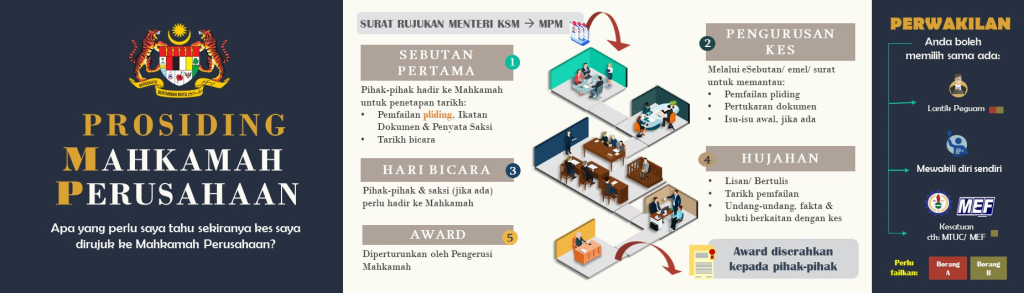
Source: Industrial Court of Malaysia (https://www.mp.gov.my/en/)
What kinds of awards can the Industrial Court make?
The Industrial Court upon determination of a matter can order the following:-
- reinstatement
- monetary compensation in lieu of reinstatement (typically one month of last drawn salary for every year of completed service)
- backwages (monies they would have earned had they not been unfairly dismissed up to 24 months of last drawn salary or up to 12 months for probationers)
- contractual entitlements (commission, bonus, etc)
- costs (if necessary, for exceptional circumstances)
CIVIL COURT
The civil courts of first instance consist of Magistrates' Courts, the Sessions Courts and the High Courts. The jurisdiction of the civil court is distinct from the industrial court in that the civil court deals with matters related to breach of contract or duty while the industrial court hears matters related to unfair dismissal or constructive dismissal.
Some examples of breach of contract:
- non-compliance with contractual terms and conditions
- non-compliance with the contractual notice period
- non-fulfillment of the contractual period
- non-fulfilment of employment bond
- misuse of confidential information/trade secrets belonging to the employer for personal gains
Some examples of breach of duty:
- interference with the business of the employer
- diversion of business of the employer
- breach of fiduciary duties
As such, an employer as an aggrieved party may bring an action in the civil courts for recovery of damages suffered as a result of the breach of the employment contract or breach of duty by the employee. The civil courts deal with claims for monetary compensation for such breaches.
The usual process in respect of civil proceedings will apply.
CONCLUSION
It is important to understand the different jurisdictions and power of the various courts so that you can file your matter at the proper forum. Making a complaint or filing a matter at the wrong court may result in time wasted, further costs incurred and dismissal of your matter by the relevant court. If in doubt, always consult your legal advisor or lawyer for legal advice.
For further information, kindly contact Kirsten Toh, Advocate and Solicitor at kirsten@tohlaws.com or +6016-206 8128.